The science

Designed with research in mind — and honest about its limits

TeoMind’s games and its adaptive difficulty were designed with reference to peer-reviewed research in child development and cognitive science. This page explains which research we draw on, how, and what we do not claim.

TeoMind's games for attention, working memory, cognitive flexibility, inhibitory control, spatial thinking and problem solving are designed with reference to research in child development and cognitive science.

Research on game-based learning, executive functions, spatial skills and game-based cognitive assessment is among the scientific frameworks that inform TeoMind's design approach.

Important: TeoMind is not an IQ test, a clinical assessment or a diagnostic tool. The results in the app reflect how your child performs on TeoMind's tasks and how that changes over time — nothing more.

Three design principles

Targeted practice

Every game targets a specific cognitive skill — working memory, inhibitory control, cognitive flexibility, attention, spatial thinking… Which game practises which skill is defined and shown to parents.

Gradual, individual challenge

Difficulty is tuned separately for each skill, so a child is stretched but not overwhelmed. Changes come in small steps, and only once enough evidence has built up.

Honest measurement

The app reports only performance on its own tasks and how it changes over time. No IQ, no diagnosis, no labels, no comparison with other children.

14 skills and the worlds that practise them

Every game is tied to one main skill. The descriptions below are the same ones parents read in the Parent Area.

Pattern Recognition

Spotting the rule in a sequence and predicting what comes next.

Practised in: Pattern Meadow

Spatial Reasoning

Turning shapes in the mind and understanding direction and position.

Practised in: Space Station, Perception Island

Visual Memory

Holding what was seen in mind for a short while and recalling it.

Practised in: Memory Cave, Space Station, Perception Island

Attention

Focusing on the target, ignoring distractions, and maintaining that focus.

Practised in: Attention Forest, Speed Track, Movement Course, Space Station, Sound Valley, Perception Island, Discovery Garden

Logic

Holding multiple rules at once and filling the gap.

Practised in: Perception Island, Discovery Garden

Classification

Telling what belongs to a group and what does not.

Practised in: Shifting World, Perception Island, Discovery Garden

Sequencing

Putting things in order by a rule.

Practised in: Pattern Meadow, Space Station, Mission Centre

Visual Analogy

Seeing a change and applying the same change elsewhere.

Practised in: Pattern Meadow

Impulse Control

Waiting for the right signal and not tapping the wrong one — holding back an impulse.

Practised in: Control Castle

Processing Speed

Responding quickly and accurately to what appears.

Practised in: Speed Track, Perception Island

Hand-Eye Coordination

Coordinating eye and hand.

Practised in: Movement Course, Discovery Garden

Auditory Attention

Picking a target sound out of others and remembering sounds in order.

Practised in: Sound Valley

Cognitive Flexibility

Switching to a new rule when the rule changes.

Practised in: Shifting World

Following Instructions

Carrying out a multi-step instruction in order.

Practised in: Mission Centre, Discovery Garden

How adaptive difficulty works

TeoMind sets difficulty not with an AI model but with clear, tested rules that run on the device. The same data always leads to the same decision.

What happens after every round?

A round is played
accuracyfalse responsesmissed targetsreaction time
The round is assessed
fluentsteadystrugglingsharp drop
A decision is made
+1 levelhold−1 level
  1. A level for every skillEach of the 14 skills has its own level from 1 to 10. The age group caps the highest level a child can reach.
  2. Difficulty has many dimensionsDifficulty is not a single speed setting: visual complexity, memory load, processing speed, distractors, instruction length, rule complexity and spatial complexity are tuned separately. A visual search never raises memory load; a memory game never raises speed.
  3. Every round is assessedAccuracy, false responses, missed targets and reaction time are compared with what the level expects, and the round is marked fluent, steady, struggling or a sharp drop.
  4. Going up needs evidenceA level rises by one when two of the last three rounds were fluent and none was a struggle. One lucky round is not enough.
  5. So does going downTwo struggles in a row, or one sharp drop, lower the level by one. A single mistake never knocks a child back.
  6. Uneven results mean waitingIf results go up and down, the level holds. A change is never bigger than one step, and after every change fresh rounds are needed.
  7. Hints are not masteryA question solved with a hint counts as a success, but not as evidence for moving up.
  8. Every challenge is validatedEach of the 2,423 challenge configurations in the catalogue is checked automatically — structure, logic (exactly one right answer), playability, level, age, layout and repetition — before a child ever sees it.

How the parent report is written

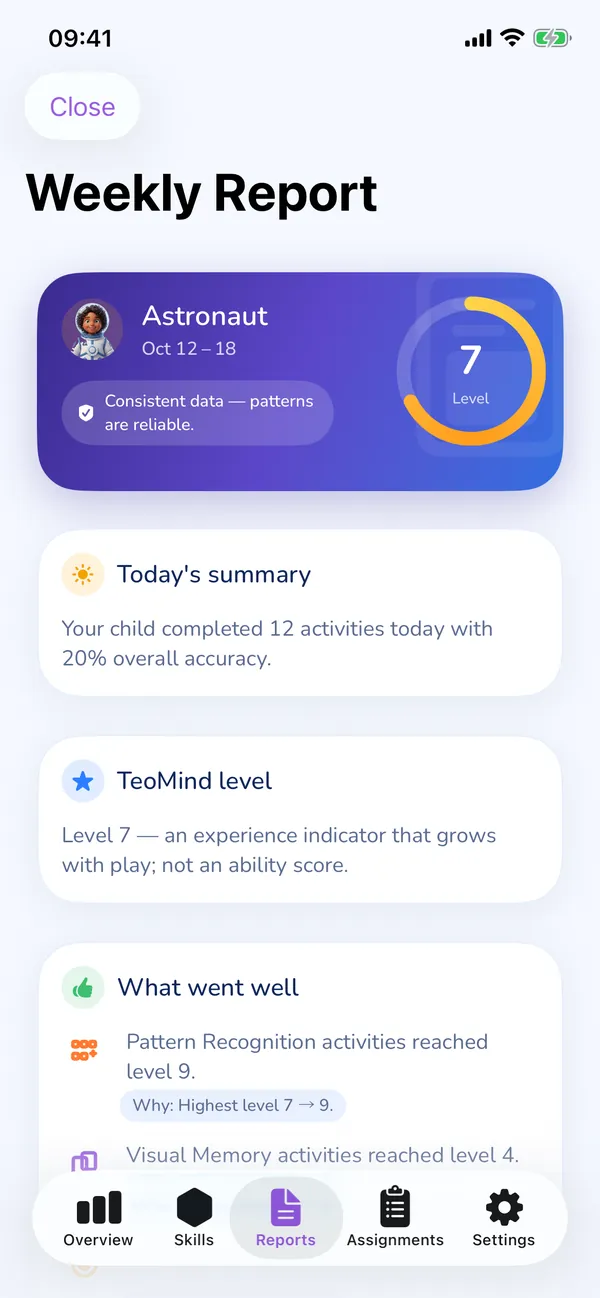
Reports are written with the same caution. The aim is to tell parents what was observed, not to pass judgement on the child.

No comment without enough data

Nothing is said about a skill until at least three recent rounds have been played. When there is little data, the report says so.

Wording follows the evidence

Strong evidence “consistently shows”, moderate evidence “suggests”, weak evidence reads “early results may indicate… not enough activity yet”.

Every comment has a reason

Each sentence shows the observation behind it (“Why: …”). It says “made fewer false taps in attention games this week” — never “has an attention problem”.

No labels, no diagnosis language

Every parent-facing text in the app is checked by automated tests for words that suggest a diagnosis or a label.

Weekly report

The research and how TeoMind applies it

These eight peer-reviewed publications are also listed in the app, on the “Scientific Foundation” screen in the Parent Area. For each one we describe what the research says and how it is reflected in TeoMind’s design.

Executive Functions

Executive Functions

Diamond, A. (2013) · Annual Review of Psychology, 64, 135–168.
Read on PubMed

What the research says

A comprehensive review of the core components of executive functions and how they develop through childhood.

How TeoMind applies it

The three core executive functions — working memory, inhibitory control (impulse control) and cognitive flexibility — each have a world of their own: Memory Cave, Control Castle and Shifting World.

In games such as “Rule Switch!” and “Which One Now?” the rule changes mid-game, and the child has to let go of the old rule and adapt to the new one.

Executive Function Development in Children

Interventions Shown to Aid Executive Function Development in Children 4 to 12 Years Old

Diamond, A. & Lee, K. (2011) · Science, 333(6045), 959–964.
Read on PubMed

What the research says

Examines a range of approaches shown to support executive function development in children aged 4 to 12.

How TeoMind applies it

Difficulty never stands still: each skill has its own level, which rises in small steps as the child grows. Practice stays a little challenging.

Games are short and made to be repeated; the daily adventure mixes different skill families afresh every day.

Executive Function Interventions

The Efficacy of Different Interventions to Foster Children’s Executive Function Skills: A Series of Meta-Analyses

Takacs, Z. K. & Kassai, R. (2019) · Psychological Bulletin, 145(7), 653–697.
Read on PubMed

What the research says

Pools a large body of studies to compare how different types of intervention affect children's executive function skills.

How TeoMind applies it

This is one reason we don’t rely on a single method or game: TeoMind practises skills through 117 different games and many types of task.

The app does not promise any particular effect size or outcome.

Executive Attention

Training, Maturation, and Genetic Influences on the Development of Executive Attention

Rueda, M. R. et al. (2005) · Proceedings of the National Academy of Sciences, 102(41), 14931–14936.
Read on PubMed

What the research says

Looks at how training and maturation relate to the development of executive attention in young children.

How TeoMind applies it

“Middle Arrow” is inspired by the flanker task widely used in attention research: the child looks only at the middle arrow and ignores the ones beside it.

Games such as “Star Hunter”, “Space Mission” and “Lantern Watch” practise focusing on a target despite distractions and holding back unneeded responses.

Spatial Skills

The Malleability of Spatial Skills: A Meta-Analysis of Training Studies

Uttal, D. H. et al. (2013) · Psychological Bulletin, 139(2), 352–402.
Read on PubMed

What the research says

A large meta-analysis of whether spatial skills can be improved through training and experience.

How TeoMind applies it

All 14 games in the Space Station are devoted to spatial skills: mental rotation, mirror images, finding routes, directions, designs and assembling pieces.

Difficulty rises gradually along spatial dimensions such as rotation angle, number of pieces and route length.

Working Memory Training

Working Memory Training in Typically Developing Children: A Multilevel Meta-Analysis

Sala, G. & Gobet, F. (2020) · Psychonomic Bulletin & Review, 27(3), 423–434.
Read on PubMed

What the research says

Reviews working memory training in children and finds that gains are clearest on the trained tasks themselves, while transfer to broader abilities is more limited.

How TeoMind applies it

That is why TeoMind never claims that progress in its games carries over to school achievement or general intelligence.

The memory games are not one exercise repeated: visual, spatial, auditory and sequential memory are each practised with different games, and reports show progress in those games only.

Digital Games and Learning

Digital Games, Design, and Learning: A Systematic Review and Meta-Analysis

Clark, D. B., Tanner-Smith, E. E. & Killingsworth, S. S. (2016) · Review of Educational Research, 86(1), 79–122.
Read on PubMed

What the research says

A systematic review and meta-analysis of how digital games relate to learning outcomes.

How TeoMind applies it

Play is split into short sessions spread over time: the daily adventure lasts about seven minutes.

The design combines immediate feedback, graded hints (the third hint shows the answer together with the child), spoken instructions and Teo as a guide.

Game-Based Cognitive Assessment

Evaluating the Validity of Game-Based Assessments Measuring Cognitive Function Among Children and Adolescents: A Systematic Review and Meta-Analysis

Aneni, K. et al. (2023) · Progress in Brain Research, 279, 1–36.
Read on PubMed

What the research says

A systematic review and meta-analysis of the validity of game-based cognitive assessment in children and adolescents. It evaluates the field in general, not TeoMind.

How TeoMind applies it

TeoMind’s reports are not presented as a measurement instrument; they show performance within the app and how it changes, together with the strength of the evidence.

This study evaluates the field in general; it is not a study validating TeoMind itself.

Limits of the evidence

Research shows that cognitive training and games can support improvement in some of the specific skills they target. It does not guarantee that gains in one skill carry over automatically to general intelligence or school achievement.

That is why TeoMind never presents results as an IQ score, a diagnosis or a comparison with other children. It focuses on performance within the app and how it changes over time.

We don’t use phrases like “scientifically proven” for TeoMind. The accurate wording is: TeoMind is designed with reference to research in these fields.

References

  1. Diamond, A. (2013). Executive Functions. Annual Review of Psychology, 64, 135–168. PubMed 23020641
  2. Diamond, A. & Lee, K. (2011). Interventions Shown to Aid Executive Function Development in Children 4 to 12 Years Old. Science, 333(6045), 959–964. PubMed 21852486
  3. Takacs, Z. K. & Kassai, R. (2019). The Efficacy of Different Interventions to Foster Children’s Executive Function Skills: A Series of Meta-Analyses. Psychological Bulletin, 145(7), 653–697. PubMed 31033315
  4. Rueda, M. R. et al. (2005). Training, Maturation, and Genetic Influences on the Development of Executive Attention. Proceedings of the National Academy of Sciences, 102(41), 14931–14936. PubMed 16192352
  5. Uttal, D. H. et al. (2013). The Malleability of Spatial Skills: A Meta-Analysis of Training Studies. Psychological Bulletin, 139(2), 352–402. PubMed 22663761
  6. Sala, G. & Gobet, F. (2020). Working Memory Training in Typically Developing Children: A Multilevel Meta-Analysis. Psychonomic Bulletin & Review, 27(3), 423–434. PubMed 31939109
  7. Clark, D. B., Tanner-Smith, E. E. & Killingsworth, S. S. (2016). Digital Games, Design, and Learning: A Systematic Review and Meta-Analysis. Review of Educational Research, 86(1), 79–122. PubMed 26937054
  8. Aneni, K. et al. (2023). Evaluating the Validity of Game-Based Assessments Measuring Cognitive Function Among Children and Adolescents: A Systematic Review and Meta-Analysis. Progress in Brain Research, 279, 1–36. PubMed 37661161